I run operations and build the systems that make them possible to run — and audit.
Rigorous remote contact-center operations, custom analytics, tooling, and quality systems — held together by one idea: ease. When the work is easier and more joyful their true potential begins to unlock.
Ingest the ugly upstream — and return something a person can actually read.
Build for the exact moment someone is looking at the screen.
Validate before you ship. Perfect before you bake.
Don’t hoard the tooling — package it so the whole team can self-serve.
Investigate before you correct. Judgment is never handed to a script.
Systems and people are one discipline — the tools exist to help supervisors develop their people, not merely watch them.
What I do
An operator who engineers.
Most operations managers don’t build their own tooling; most tool-builders don’t run teams. I do both. Over the past year I ran a customer-experience program for a global consumer tech manufacturer, moving from Operations Manager to Implementation Lead for its third-party CX certification. Along the way I built most of the analytical and operational infrastructure the site runs on, while running a team with the discipline that infrastructure was designed to serve.
For a decade, overlapping my first years in operations, I worked in medical devices as a product manager and co-founder. I became a named inventor on five U.S. biopsy-device patents, carried products through two acquisitions, and supported physicians in live procedures, troubleshooting in real time. Different industry, same instinct: understand the problem deeply, then build the thing that solves it.
translation between systemsmanual labor and stressinefficiencyauditabilityidempotency between reportsreporting grainsdimensions, measures, detailfriction and noise
Operations Leadership
Ran a contact-center operation of 10 supervisors and ~200 advisors. An unbroken weekly one-on-one with every supervisor, a monthly operating standard for the whole team, and a supervisor onboarding program built from scratch. A closed-loop coaching model that measures whether coaching actually moved the metric — and launched a new line of business end to end.
~50 leaders · one application · one operating system
ILLUSTRATIVE FIGURES · REAL PATTERN
Analytics & Data Engineering
Turn hostile raw exports into tools people actually use. Advanced dynamic-array Excel (LET, LAMBDA, FILTER, XLOOKUP), Power Query M, SAP BusinessObjects design, and a weekly ETL pipeline over enterprise BI sources. The centerpiece: an operations dashboard that runs entirely offline — one operating system synthesized from raw workforce and performance data — used every day by ~50 supervisors and managers.
01 / 04THE SOURCES
Bring the upstream data together.
Thirteen data sources + operating extracts
02 / 04THE CANONICAL COPY
One folder becomes the source.
Queries + extracts → single upstream
03 / 04THE CADENCE
Refresh once. Carry it forward.
Canonical dataset → weekly refresh
04 / 04THE REACH
Every downstream tool stays connected.
Dashboard · attendance · quality · coaching
ILLUSTRATIVE FIGURES · REAL PATTERN
Software & Tooling
Build self-contained offline web applications (HTML, CSS, JavaScript), Chrome extensions (Manifest V3), Python build pipelines, and VBA automation — an ecosystem of internal tools that replaced manual reporting across attendance, adherence, quality, coaching, staffing, and cost, and put self-serve analytics in every supervisor’s hands.
01 / 04THE FILE
The application is the file.
Interface + data + parser · one HTML file
02 / 04THE SAVE
Work stays in the browser.
Edits → IndexedDB · local autosave
03 / 04THE COPY
A copy carries its own state.
Save copy → data baked into the HTML
04 / 04THE HANDOFF
Open the file. Pick up the work.
One portable application · server count 0
ILLUSTRATIVE FIGURES · REAL PATTERN
Quality & Standards
Certified implementation leader (third-party CX standard R8.0); led the site to recertification in May 2026 against the rigorous third-party customer-experience standard the client requires. DMAIC problem-solving, statistically-sampled quality measurement, and target-setting governance that aligns metrics with defensible, auditable measurement rather than reporting artifacts.
01 / 04THE STANDARD
Give each clause somewhere to point.
Standard → clause → evidence
02 / 04THE CROSSWALK
Make the evidence traceable.
Clause → cited artifact · one visible chain
03 / 04THE CASE
Keep the corrective action intact.
Observation → actions → evidence → compliance case
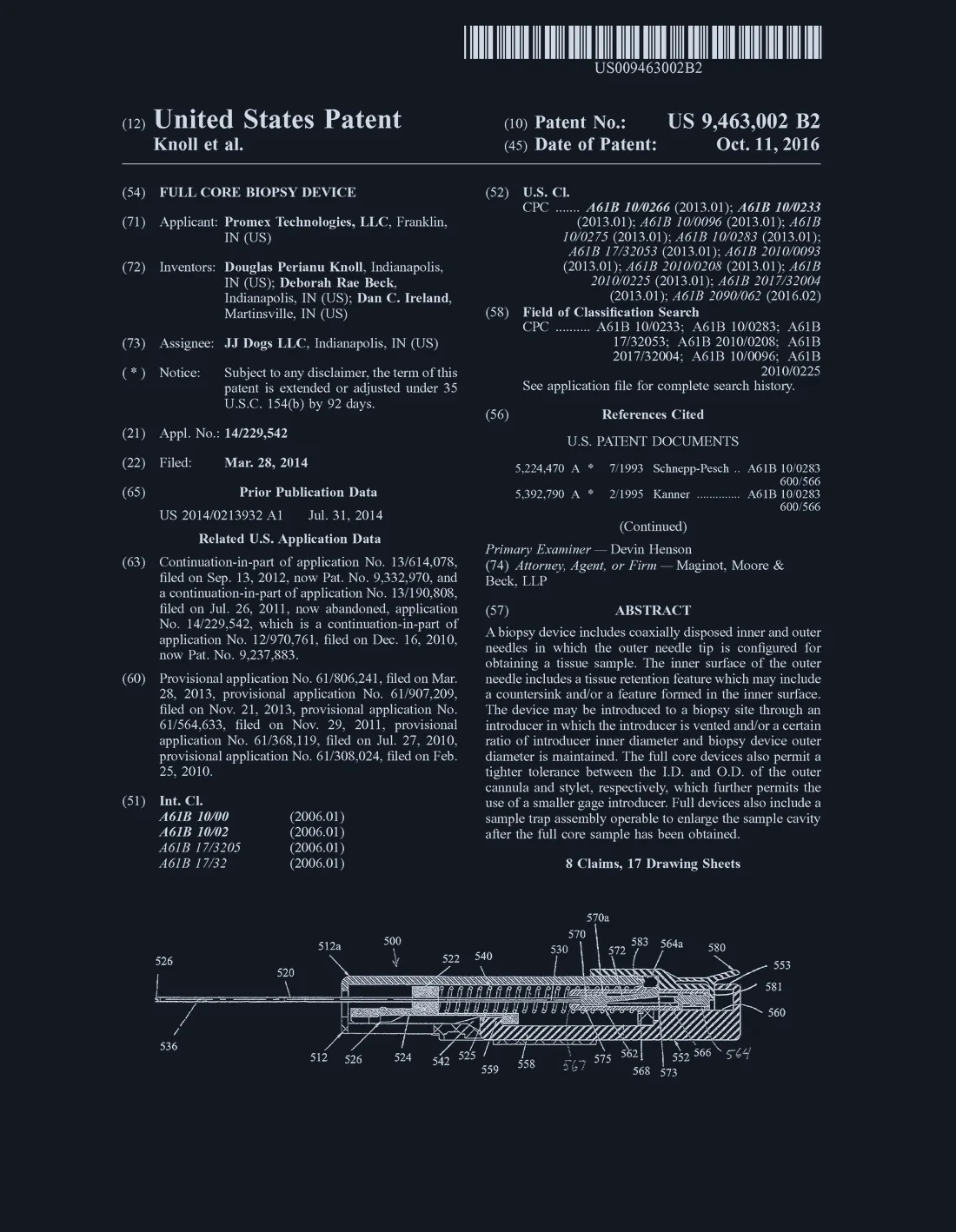
Douglas Perianu Knoll, Indianapolis, IN (US); Deborah Rae Beck, Indianapolis, IN (US); Dan C. Ireland, Martinsville, IN (US)
Assignee
JJ Dogs LLC, Indianapolis, IN (US)
Abstract, as granted
A biopsy device includes coaxially disposed inner and outer needles in which the outer needle tip is configured for obtaining a tissue sample. The inner surface of the outer needle includes a tissue retention feature which may include a countersink and/or a feature formed in the inner surface. The device may be introduced to a biopsy site through an introducer in which the introducer is vented and/or a certain ratio of introducer inner diameter and biopsy device outer diameter is maintained. The full core devices also permit a tighter tolerance between the I.D. and O.D. of the outer cannula and stylet, respectively, which further permits the use of a smaller gage introducer. Full devices also include a sample trap assembly operable to enlarge the sample cavity after the full core sample has been obtained.
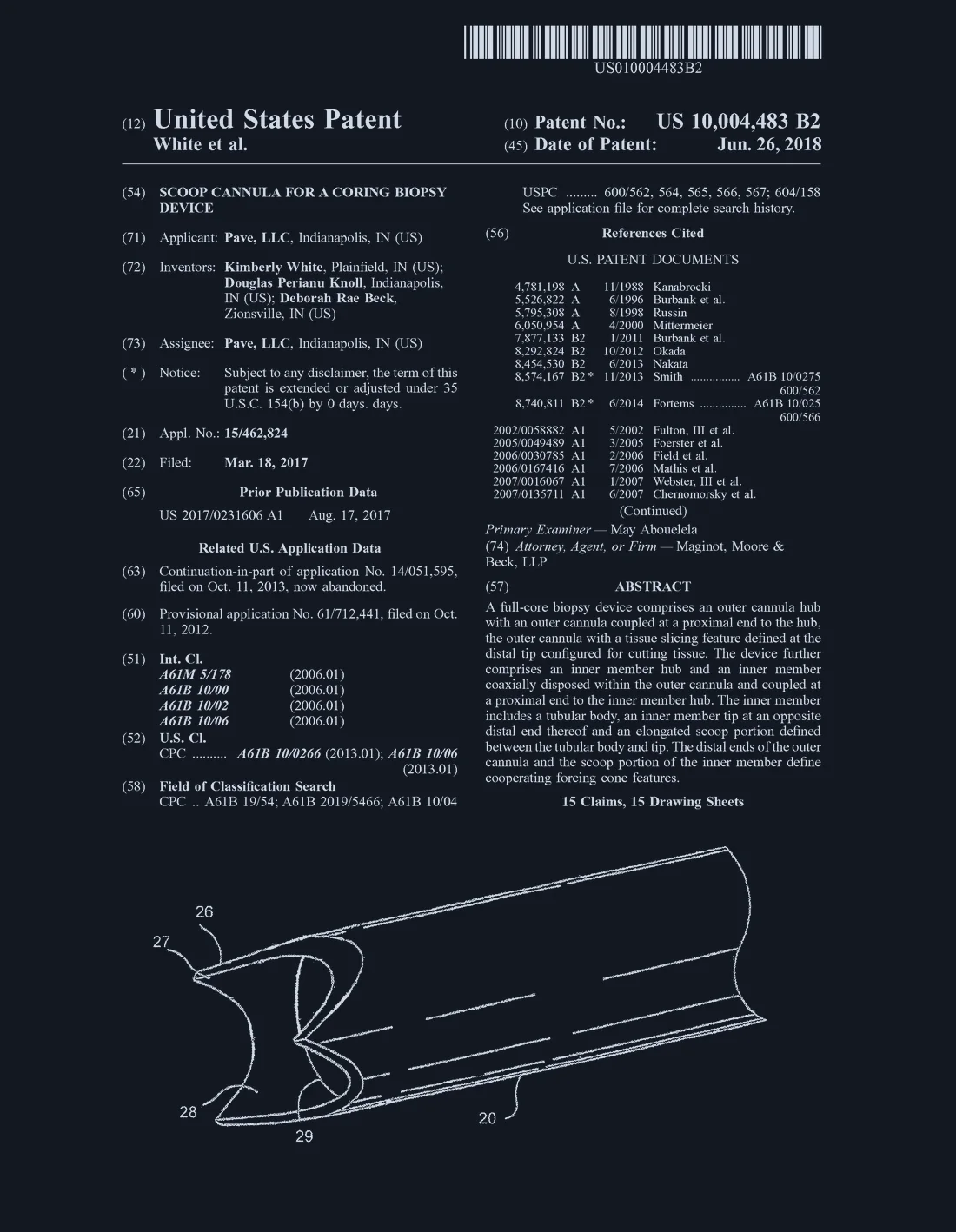
Kimberly White, Plainfield, IN (US); Douglas Perianu Knoll, Indianapolis, IN (US); Deborah Rae Beck, Zionsville, IN (US)
Assignee
Pave, LLC, Indianapolis, IN (US)
Abstract, as granted
A full-core biopsy device comprises an outer cannula hub with an outer cannula coupled at a proximal end to the hub, the outer cannula with a tissue slicing feature defined at the distal tip configured for cutting tissue. The device further comprises an inner member hub and an inner member coaxially disposed within the outer cannula and coupled at a proximal end to the inner member hub. The inner member includes a tubular body, an inner member tip at an opposite distal end thereof and an elongated scoop portion defined between the tubular body and tip. The distal ends of the outer cannula and the scoop portion of the inner member define cooperating forcing cone features.
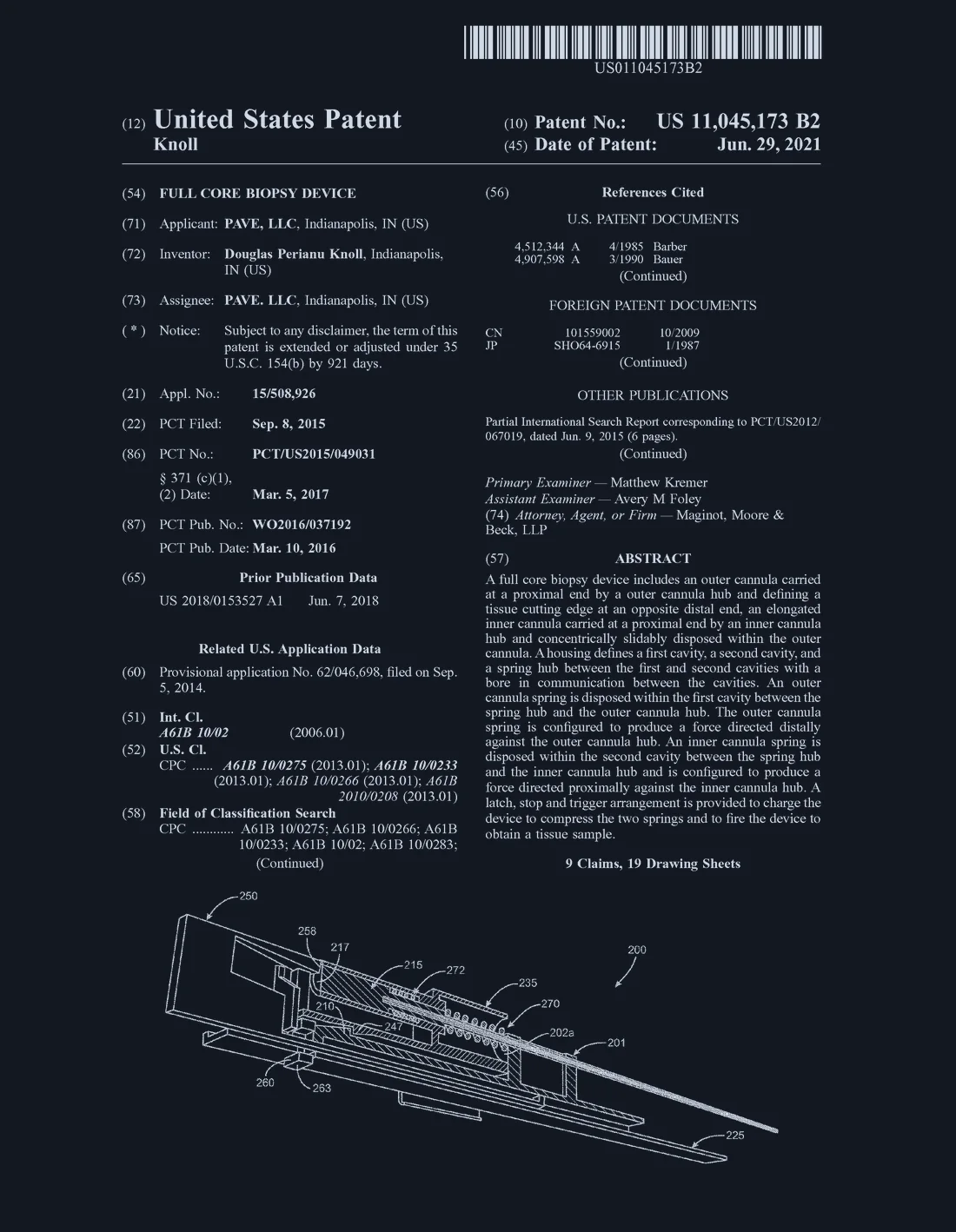
A full core biopsy device includes an outer cannula carried at a proximal end by a outer cannula hub and defining a tissue cutting edge at an opposite distal end, an elongated inner cannula carried at a proximal end by an inner cannula hub and concentrically slidably disposed within the outer cannula. A housing defines a first cavity, a second cavity, and a spring hub between the first and second cavities with a bore in communication between the cavities. An outer cannula spring is disposed within the first cavity between the spring hub and the outer cannula hub. The outer cannula spring is configured to produce a force directed distally against the outer cannula hub. An inner cannula spring is disposed within the second cavity between the spring hub and the inner cannula hub and is configured to produce a force directed proximally against the inner cannula hub. A latch, stop and trigger arrangement is provided to charge the device to compress the two springs and to fire the device to obtain a tissue sample.
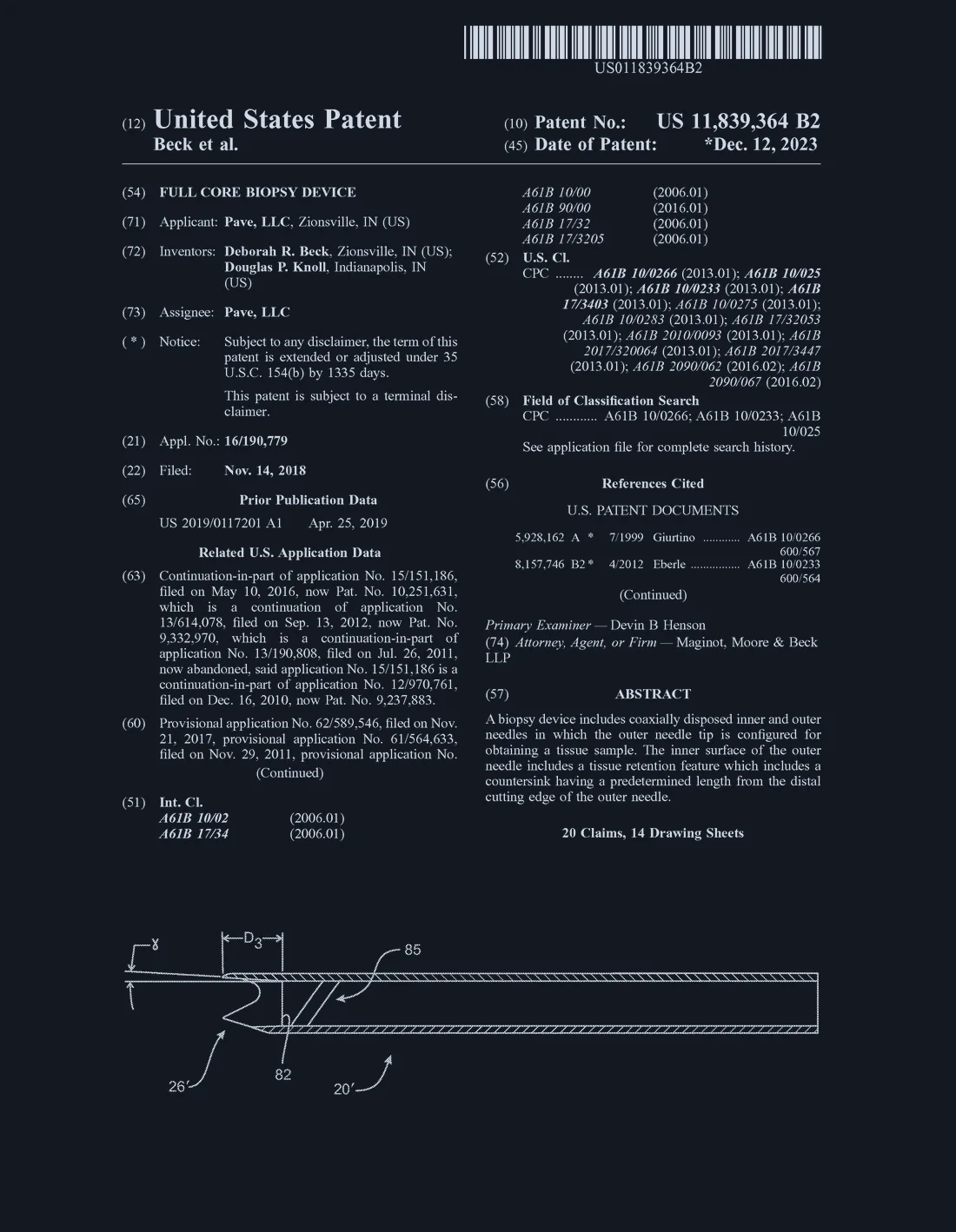
Deborah R. Beck, Zionsville, IN (US); Douglas P. Knoll, Indianapolis, IN (US)
Assignee
Pave, LLC
Abstract, as granted
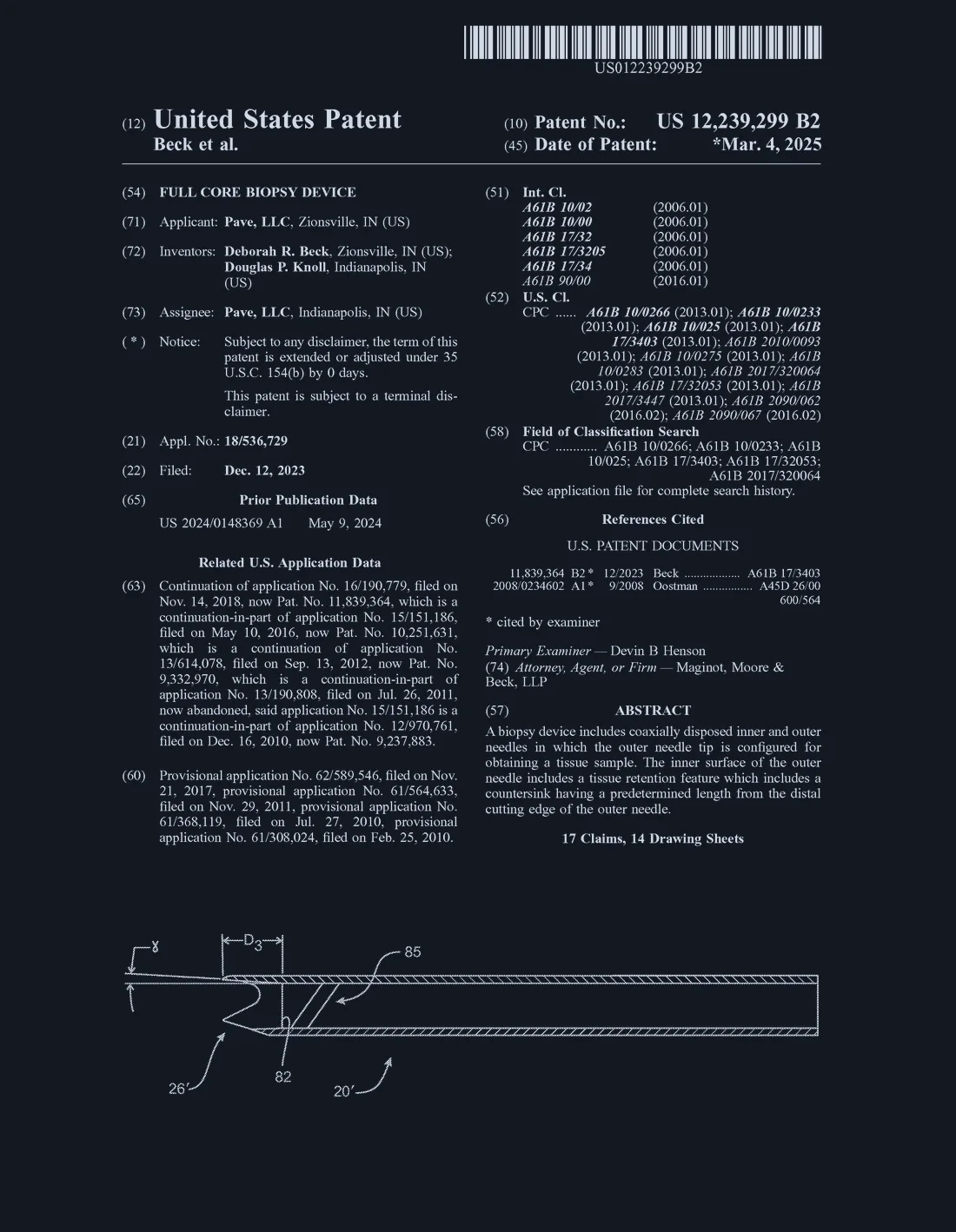
A biopsy device includes coaxially disposed inner and outer needles in which the outer needle tip is configured for obtaining a tissue sample. The inner surface of the outer needle includes a tissue retention feature which includes a countersink having a predetermined length from the distal cutting edge of the outer needle.
Deborah R. Beck, Zionsville, IN (US); Douglas P. Knoll, Indianapolis, IN (US)
Assignee
Pave, LLC, Indianapolis, IN (US)
Abstract, as granted
A biopsy device includes coaxially disposed inner and outer needles in which the outer needle tip is configured for obtaining a tissue sample. The inner surface of the outer needle includes a tissue retention feature which includes a countersink having a predetermined length from the distal cutting edge of the outer needle.
Grouped by company — expand any role for the full detail.
VXI Global SolutionsJul 2025 – Present
Implementation Lead, third-party CX certificationLed the site to third-party CX recertification in May 2026 and rebuilt its measurement governance.Mar 2026 – Present
Certified as an implementation leader in the third-party CX standard, Release 8.0; promoted to lead the site’s recertification program, and led it to recertification in May 2026.
Serve the site by leading the site’s certification work across operations, workforce management, quality, and training — drove its corrective actions to closure.
Rebuilt KPI target-setting methodology and governance, correcting Schedule Attainment, Utilization, and Bill-to-Pay formulas for defensible, auditable measurement.
Designed a statistically-sampled escalation-accuracy measurement program and architected the DMAIC corrective-action plan for the site’s top dissatisfaction driver.
Corrected data-integrity issues at the query source, eliminating manual transcription and enabling automated analysis.
Operations ManagerRan a ~200-advisor operation and built the analytics stack it runs on.Jul 2025 – Mar 2026
Managed 10 supervisors and ~200 advisors, with an unbroken weekly one-on-one with every supervisor and a monthly operating standard for the team.
Conceived and built the site’s daily operating dashboard — an offline application synthesizing raw workforce and performance data into one operating system — used daily by ~50 supervisors and managers.
Built a fleet of analytical tools on a shared roster backbone and a weekly ETL pipeline over SAP BusinessObjects and Superset, replacing manual reporting across attendance, adherence, quality, coaching, staffing, and cost.
Stood up a new line of business — launch command center through early quality audits — and authored the supervisor onboarding program.
Ran a closed-loop coaching model that records a before/after metric delta for every session and confirms automated recommendations with the person before any action.
SupervisorTop CSAT and resolution scores within two months.Apr 2021 – Jun 2022
Led a team of 20+ direct reports while managing attendance, adherence, compliance, training, and timekeeping.
Achieved top customer-satisfaction and resolution scores for the line of business within the first two months; offered a permanent role well ahead of standard timelines.
Reinvented mentoring recruitment with a master recruitment tool and developed top candidates into impactful mentors.
Created a structured support system facilitating chat support to phone agents during heavy volume.
Product Manager / Co-FounderInvented biopsy technology; three patents; assisted the exit.2015 – 2022
Invented biopsy technology — U.S. Patents US11045173B2, US11839364B2, and US12239299B2, with EU/JP counterparts — working directly with a patent attorney.
Designed, conducted, and analyzed in vivo and benchtop testing with prototype devices to finalize specifications.
Assisted in the successful exit and transfer of technology to the Mermaid Medical team.